Eine Sammlung ist das Kernstück eines Museums, sie stellt neben Ausstellungen den bleibenden und identitätsstiftenden Existenzgrund eines Museums dar; diese These stimmt auch für das Skulpturenmuseum Glaskasten Marl, dessen Skulpturensammlung ein sehr spezielles Profil besitzt. Deshalb steht die Bestandsaufnahme der Sammlung des Museums am Anfang einer Reihe von Veränderungen, mit denen der neue Direktor Georg Elben seine Arbeit in Marl aufnimmt. Die Sammlung wird – neu geordnet – zusammen mit Leihgaben bei der Eröffnung am 16. Oktober im Mittelpunkt stehen und in den folgenden Monaten als „work-in-progress“ weiter verändert werden.
Das Gesicht der ersten neuen Präsentation prägen Leihgaben aus dem Duisburger Lehmbruck Museum, sowie von privaten Leihgebern, vor allem jedoch von Künstlern, die mit Leihgaben oder neuen Werken auf die besondere Atmosphäre der Museumsarchitektur und der Sammlung reagiert haben. Zu jeder der kommenden Ausstellungseröffnungen wird auch die Sammlung weiter verändert. Das Scharnier zwischen Exponaten der eigenen Sammlung und den Gästen, aber auch zur Ausstellungsreihe „Der Raum als Prüfstein“ ist die Intervention der Düsseldorfer Künstlerin Erika Hock.
Für den inneren Glaskasten im Erdgeschoß entwirft Hock eine Präsentationsstruktur, die vordergründig eine ordnende Funktion im Ausstellungsraum zu übernehmen scheint. Einem modularen Regalsystem ähnlich beherbergt ihre Arbeit zahlreiche Skulpturen und Kleinplastiken, die dem Besucher das gleichzeitige Betrachten der einzelnen Objekte ermöglicht. Der Blick wird, anders als bei klassisch-musealen Präsentationsweisen, die den Besucher meist durch eine Anordnung von Sockeln lenken, auf ein Simultanbild ausgerichtet. Erika Hocks Arbeit versteht sich als eine eigenständige Architektur, die dem Konzept eines Pavillons folgend auf ein nomadisches Dasein und eine Neubespielung ausgerichtet ist. In diesem Display werden bedeutende Bestände des Museums, etwa von Rudolf Belling, Max Ernst oder Alberto Giacometti zusammen mit hochrangigen Leihgaben von Norbert Kricke oder Henri Laurens und Skulpturen junger Künstler wie Diango Hernandez, Gert und Uwe Tobias oder Paloma Varga Weisz durch ihre Anordnung und Gegenüberstellung in ein neues Licht gerückt.
Die Ausstellungsreihe „Der Raum als Prüfstein“
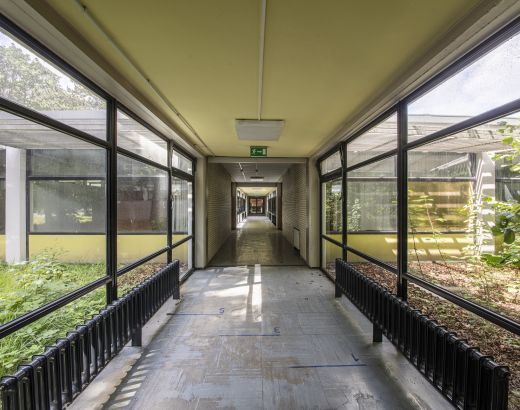
Diese in den kommenden Monaten kontinuierlich veränderte Neupräsentation der Sammlung stellt die Folie dar, auf die sich die Ausstellungsreihe „Der Raum als Prüfstein“ im Projektraum im Untergeschoss bezieht. Die spezifischen architektonischen Bedingungen eines Raumes, hier ist es der einzige weitgehend geschlossene Ausstellungsraum im Untergeschoß des Skulpturenmuseum Glaskasten Marl, wird zum Prüfstein, auf dessen dominante Vorgaben installativ arbeitende Künstler reagieren müssen. Die Reihe von (vorerst) vier Ausstellungen reicht von dem im vergangenen Jahr verstorbenen Stahlbildhauer Ansgar Nierhoff über Diango Hernandez im Dezember 2011 bis hin zum Düsseldorfer Manuel Graf im kommenden Frühjahr.
Für alle gelten die gleichen Bedingungen: es ist ein hermetisch wirkender, langgestreckter Raum mit vertikalen Gliederungen und ausschließlich künstlichem Licht. Diese Bedingungen sind für alle beteiligten Künstler gleich; sie ermöglichen sowohl eine Profilierung junger, als auch eine kritische Bestandsaufnahme etablierter Positionen, deren Ausstellungen durch eine relativ kurze Laufzeit und nach Möglichkeit von einem kleinen Katalog begleitet unmittelbar miteinander in Beziehung gesetzt werden.
Die Künstler werden für diese räumliche Situation neue Arbeiten entwickeln, welche auf die architektonischen Gegebenheiten, aber auch auf die spezifische Ausrichtung des Skulpturenmuseums eingehen. Die Ausstellung von Ansgar Nierhoff ist insofern eine Ausnahme, da von ihm eine ältere Werkgruppe gezeigt wird. Nierhoff ist dem Museum seit 1986 verbunden, denn seit diesem Jahr steht eine Skulptur hinter dem Museum am Eduard-Weitsch-Weg. Von ihm wird die bislang selten gezeigte Werkgruppe der „Eisenzeichnungen“ gehängt, bei denen Nierhoff trotz der Schwere des Materials und der gewaltigen Kraft, mit der dieses bearbeitet wird, eine erstaunlich leichte und spontane Wirkung erzielt. Zusammen mit den 7 freiformgeschmiedeten „Streckungen“ und einer spielerischen „Bündelung“ erschließt sich auf nur 80 m² die ganze künstlerische Bandbreite des Kölner Bildhauers. |
A museum’s permanent collection is its core and principle asset; alongside exhibitions, it plays the primary role in forming each institution’s identity and the basis for long-term existence. This notion is also certainly true for the Skulpturenmuseum Glaskasten [Glass-Box Sculpture Museum] in Marl with its particularly distinctive collection of sculpture. It is for this reason that a re-evaluation of the museum’s inventory is the first item on a list of changes to be made by its new director Georg Elben upon his commencement of work in Marl. Together with a number of works on loan, the newly arranged collection will constitute the central focal point of the exhibition opening on 16 October and will continue to be revised as a ‘work in progress’ over the months to follow.
The character of the new presentation will be informed by works on loan from the Lehmbruck Museum in Duisburg as well from private lenders but, above all, from artists who have responded to the museum’s collection and the unique atmosphere of its architecture by providing it with both loaned and also entirely new works. For the opening of each coming exhibition, the collection will be further amended. The pivotal link that will guide guests through the single exhibits from the permanent collection and finally lead to the exhibition series ‘Der Raum als Prüfstein’ [The Space as Touchstone] is comprised of the intervention art of Erika Hock.
For the interior of the glass box comprising the ground floor, Hock has created a presentation structure that ostensibly appears to provide a regulative function within the exhibition space. Similarly to a modular system of shelving, her work accommodates numerous sculptures and small-scale objects and thus allows visitors to view the single pieces at once. In contrast to the way that more classical museum-presentation styles tend to guide visitors through an assembly of pedestals, the gaze is now directed toward a simultaneous array. Erika Hock’s work is to be understood as autonomous architecture that, based to some degree on the concept of a pavilion, is oriented toward the notion of nomadic existence and the ability to restage things. With this display structure, important pieces from the museum’s collection—such as works by Rudolf Belling, Max Ernst or Alberto Giacometti—are presented together with outstanding borrowed works by Norbert Kricke or Henri Laurens and sculptures by young artists including Diango Hernandez, Gert and Uwe Tobias or Paloma Varga Weisz in an entirely new light through the unexpected arrangements and resultant juxtapositions.
The Exhibition Series ‘Der Raum als Prüfstein’ [The Space as Touchstone]
The evolvement of this continually changing presentation and reintroduction of the collection in new ways over the coming months provides the backdrop for the exhibition series ‘Der Raum als Prüfstein’ that will be located on the lower level of the museum. The specific architectonic parameters of a given space—in this case, the only largely enclosed exhibition space at the Skulpturenmuseum Glaskasten in Marl on the lower floor—are adopted with all of their imperative precepts as the touchstone to which the artists working with installation are forced to react. The series of (at present) four exhibitions ranges from showing work by the late steel-sculptor Ansgar Nierhoff (who passed away last year) to Diango Hernandez in December 2011 up to the Düsseldorf-based artist Manuel Graf in the coming spring.
Each artist is faced with handling the same conditions: a rather hermetical, long stretched room with vertical subdivisions and exclusively artificial light. These parameters are constants for all of the artists and thus allow for a profiling of more recent positions as well as a critical evaluation of more established approaches, which will all be placed—through the relatively short duration of each exhibition and, when possible, the emergence of a small accompanying catalogue—into immediate correlation with one another.
The artists will develop works comprised of new spatial situations that respond not only to the architectonic givens but also to the specific orientation of the Skulpturenmuseum. The Ansar Nierhoff exhibition remains an exception in that regard, as an older series of his works will be shown. Nierhoff has been connected with the musem since 1986 in that one of his sculptures was erected to the rear of the building in the Eduard-Weitsch-Weg. For the coming exhibition of his work, the rarely shown Eisenzeichnungen series will be displayed. With these works, Nierhoff achieved—despite the great weight of the working material—an astonishingly light and spontaneous effectuality. Together with his seven hammer-forged Streckungen and the playful Bündelung, the entire artistic spectrum of his work is revealed to the visitor within a mere eighty square meters of space. |